Can You Get a DUI on an E-Bike? State Laws, Penalties & What You Need to Know in 2026
Can you get a DUI on an e-bike? Yes, in most states you can, and penalties often mirror those for automobile DUIs—including fines up to $2,000, license suspension, and jail time. This guide covers how e-bike classification affects your legal exposure, state-by-state enforcement, and what happens if you're charged.
How E-Bikes Are Legally Classified and Why It Matters for DUI
Your e-bike's classification determines whether you face a full DUI charge or a lesser public intoxication citation. The difference between a Class 1 and Class 3 e-bike could mean the difference between a warning and a criminal record.
The United States uses a three-tier classification system adopted by 26 states:
| Class | Motor Type | Max Speed | Typical DUI Treatment |
|---|---|---|---|
| Class 1 | Pedal-assist only | 20 mph | Often treated as bicycle |
| Class 2 | Pedal-assist + throttle | 20 mph | Often treated as bicycle |
| Class 3 | Pedal-assist | 28 mph | More likely treated as motor vehicle |
States like California and Florida classify e-bikes as motor vehicles for DUI purposes regardless of class. Minnesota takes a narrower approach, applying motor vehicle DUI laws only when an e-bike exceeds standard speed or power thresholds. Custom conversions and high-powered models that exceed 750W face stricter classification everywhere.
Motor power thresholds matter significantly. Standard e-bikes operate within 250–750 watts. Exceed that range, and your e-bike transforms into a moped or motorcycle under state law BoltBikers.
State-by-State E-Bike DUI Laws: Where You Can Be Charged
Most states allow DUI charges for e-bike riders, but enforcement intensity varies dramatically. Your zip code determines your legal risk more than your behavior does.
States where e-bikes ARE subject to full DUI laws:
- California: Full DUI penalties apply; treated as motor vehicle
- Florida: Standard DUI enforcement; license suspension possible
- Michigan: Motor vehicle classification; full penalty range
- New York: Fines and imprisonment possible
- Oregon: Uniform DUI enforcement across all e-bikes
- Washington: Motor vehicle penalties apply
States with lighter or bicycle-specific treatment:
- Colorado: Treated more like bicycle infractions
- Minnesota: Applies only if e-bike meets motor vehicle criteria
- Some states use "cycling while intoxicated" statutes with reduced penalties
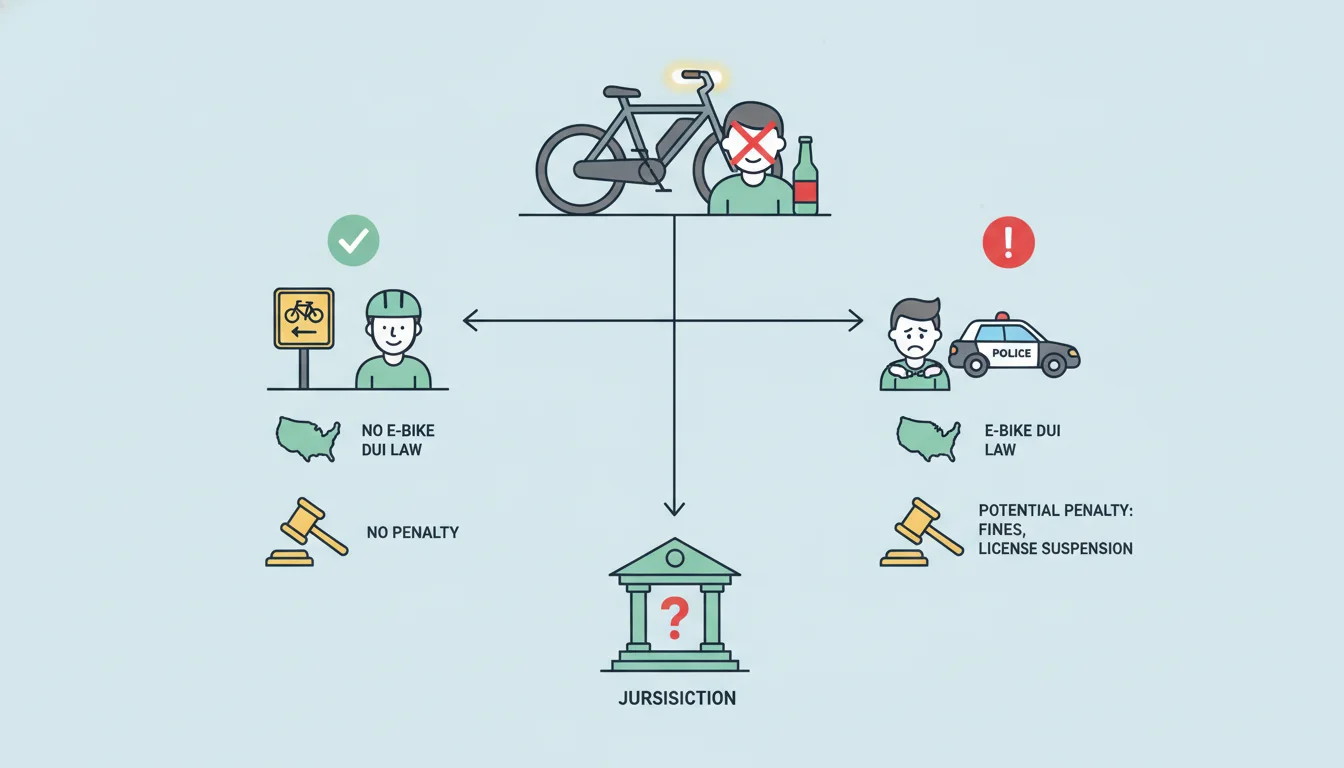
Gray zones create real problems. Local jurisdictions add their own ordinances on top of state law, and federal land like national parks follows different rules entirely. Checking your city's municipal code matters as much as knowing state law.
Before your next evening ride, verify your local laws through your state DMV website Intoxalock.
DUI vs. Public Intoxication: Understanding the Legal Difference
Even in states where e-bike DUI doesn't apply, public intoxication charges fill the gap. You're not off the hook just because your state treats e-bikes as bicycles.
| Charge Type | Typical Fine | Jail Risk | License Impact | Criminal Record |
|---|---|---|---|---|
| DUI | $500–$2,000+ | Yes, days to months | Suspension likely | Yes, serious |
| Public Intoxication | $100–$500 | Rarely | None | Yes, minor |
| Reckless Endangerment | $500–$1,500 | Possible | Varies | Yes |
The 0.08% BAC threshold applies to e-bike DUIs in states that treat them as motor vehicles. Some states use OWI (Operating While Intoxicated) or OUI (Operating Under the Influence) terminology, but the practical effect remains identical.
Here's what trips people up: reckless endangerment charges apply regardless of vehicle classification. Swerving into pedestrians while drunk on a Class 1 e-bike still creates criminal liability in every state Sandpoint Law Office.
Penalties and Consequences of an E-Bike DUI
First-offense e-bike DUI penalties hit harder than most riders expect. The consequences extend far beyond the initial fine.
Typical first-offense penalties:
- Fines: $500–$2,000, escalating with high BAC
- Jail time: 1–30 days depending on state
- Probation: 6–12 months with sobriety monitoring
- Mandatory alcohol education programs
- Driver's license suspension (yes, even for e-bike offenses)
Long-term consequences:
- Insurance rate increases or policy cancellation
- Criminal record affecting employment applications
- Housing application complications
- Background check failures for years
The license suspension catches people off guard. You don't need a license to ride an e-bike, but states suspend your car-driving privileges anyway as a deterrent. Multiple offenses escalate to felony charges in most jurisdictions.
A BAC above 0.15% triggers enhanced penalties in many states. Causing an accident while intoxicated compounds charges significantly [Haoqi Ebike].
Can You Ride an E-Bike If You Already Have a DUI?
It depends entirely on your state's classification system and your specific court order. Assuming e-bike riding is permitted during license suspension creates serious legal risk.
Factors determining your ability to ride:
- State e-bike classification (bicycle vs. motor vehicle)
- Specific language in your court order
- E-bike class (Class 3 restrictions are more common)
- Ignition interlock device requirements
- Probation conditions
States that treat e-bikes as bicycles generally permit riding during license suspension. States that classify them as motor vehicles typically prohibit any motorized operation. Your court order overrides state defaults in either direction.
A word of caution: violating license suspension terms—even unknowingly—triggers additional charges. Consult a DUI attorney before riding any e-bike during suspension. The consultation fee costs far less than a second offense.
E-Scooters and Ride-Share Liability: Bird, Lime, and Beyond
Rental e-scooters and e-bikes follow the same DUI rules as personally owned vehicles. The rental agreement doesn't create a legal shield.
Bird, Lime, and similar platforms include user agreement clauses prohibiting intoxicated use. Violating these terms creates civil liability beyond criminal charges. Companies track incident reports and permanently ban users.
Liability stacks in uncomfortable ways. Criminal DUI charges, civil liability for accidents, platform bans, and increased personal insurance rates can all compound from a single incident.
Ride-share companies report violations to law enforcement in accident situations. The $15 Uber ride home costs nothing compared to the $5,000+ total expense of an e-scooter DUI.
How to Stay Safe and Legal When Riding Your E-Bike
Impaired riding endangers you and others regardless of legal classification. The safety argument matters more than technicalities about which charges apply.
Practical alternatives:
- Designate a sober rider for group outings
- Use ride-share apps for the return trip
- Walk your e-bike home (not riding means no DUI)
- Lock your e-bike and retrieve it the next day
- Plan drinking locations near your home
Know your local laws before the situation arises. Look up your state's e-bike classification, your city's municipal codes, and any trail-specific rules for paths you use regularly.
The real safety issue: e-bikes reach 20–28 mph with minimal protective equipment. Alcohol impairs balance and reaction time. The physics don't care about legal classifications when you hit pavement at speed.
FAQ
Does a breathalyzer test apply to e-bike riders?
Yes, in states that treat e-bikes as motor vehicles. Standard DUI detection methods apply, including field sobriety tests and breathalyzer testing at the officer's discretion.
Are Class 1 e-bikes safer from DUI charges than Class 3?
Generally, yes. Class 1 bikes have better odds of bicycle classification, but state law overrides class distinctions in California, Florida, and similar jurisdictions.
What if I'm under 21 and riding an e-bike after drinking?
Zero-tolerance laws apply in many states. Any measurable alcohol triggers penalties, with consequences often more severe than adult first-offense DUI.
Do e-bike DUI charges appear on background checks?
Yes. DUI convictions create criminal records that appear on standard background checks for employment, housing, and professional licensing for 7–10 years or longer.
Can I refuse a breathalyzer test on an e-bike?
Implied consent laws vary by state. Refusal often triggers automatic license suspension and creates negative inference in court proceedings.
Does homeowner's insurance cover e-bike DUI accidents?
Rarely. Most policies exclude intentional acts and criminal conduct. You face personal liability for damages beyond any coverage limits.
Are there e-bike DUI checkpoints?
Not specifically, but standard DUI checkpoints stop all vehicles—including e-bikes—in states with motor vehicle classification. Bike paths typically have no checkpoint enforcement.
What's the statute of limitations for e-bike DUI charges?
Typically 1–3 years depending on state, matching standard DUI statutes. Prosecutors can file charges long after the incident if evidence supports the case.
Share this post
Related Posts
Why Is My Ebike Throttle Not Working? 8 Common Causes and Fixes
Why Is My Ebike Throttle Not Working? 8 Common Causes and Fixes
Can E-Bikes Be Ridden in the Rain? Complete Guide to Wet Weather Riding in 2026
Can E-Bikes Be Ridden in the Rain? Complete Guide to Wet Weather Riding in 2026
Do You Need a Driver's License for an E-Bike? 2026 State-by-State Guide
Do You Need a Driver's License for an E-Bike? 2026 State-by-State Guide