Do You Need a Driver's License for an E-Bike? 2026 State-by-State Guide
Most electric bikes in the United States do not require a driver's license. Thirty-six states now use a three-tiered classification system that treats standard e-bikes as bicycles rather than motor vehicles. This guide covers specific requirements by e-bike class, state regulations, and situations where licensing becomes mandatory.
Understanding E-Bike Classifications: Class 1, 2, and 3
Whether you need a driver's license for an e-bike depends entirely on your bike's classification. Federal law under the Consumer Product Safety Act defines e-bikes as two- or three-wheeled vehicles with motors under 750 watts and maximum speeds of 20 mph when powered solely by the motor.
| Class | Assistance Type | Max Speed | License Required | Where You Can Ride |
|---|---|---|---|---|
| Class 1 | Pedal-assist only | 20 mph | No (all states) | Bike paths, trails, roads |
| Class 2 | Throttle-assist | 20 mph | No (most states) | Bike paths, trails, roads |
| Class 3 | Pedal-assist only | 28 mph | Varies by state | Roads, some bike paths |
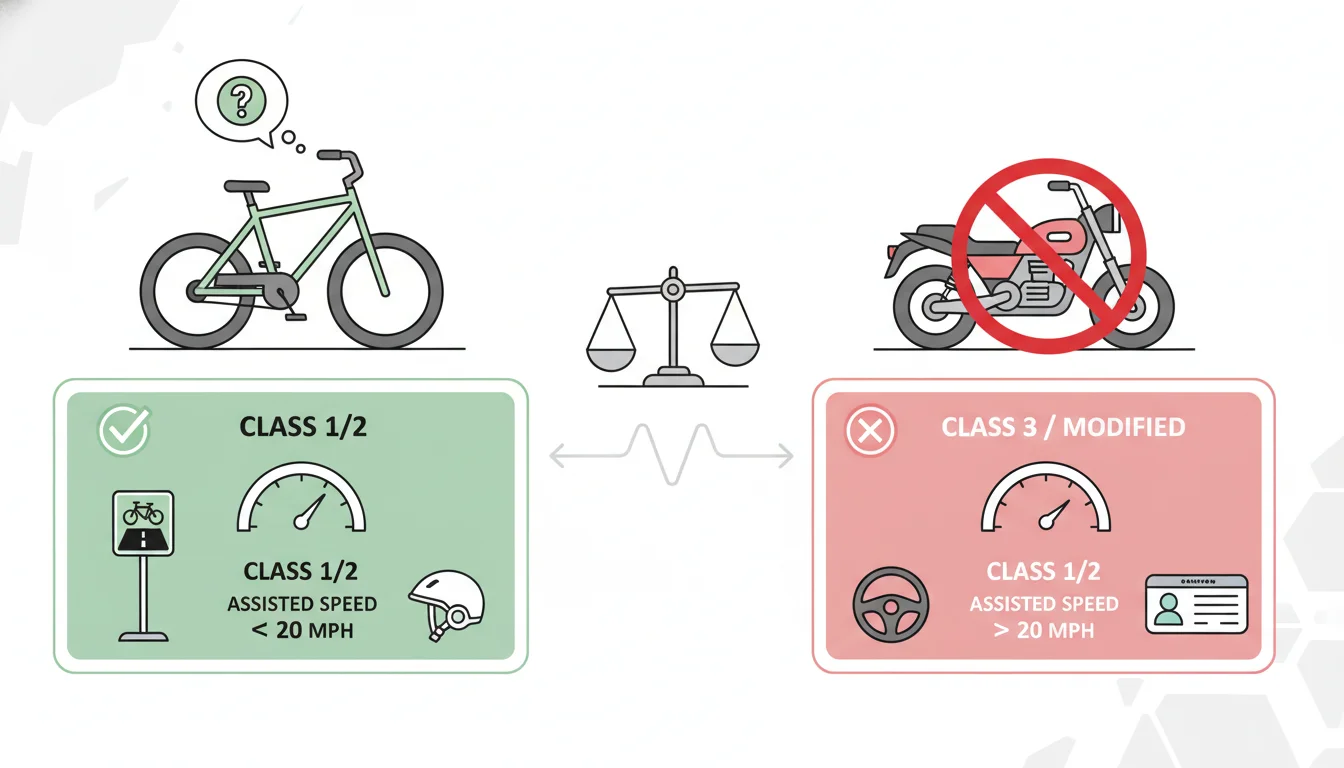
Class 1 e-bikes provide electric assistance only when pedaling and cut off at 20 mph. These face zero licensing requirements anywhere in the country. Class 2 e-bikes add throttle capability but maintain the same 20 mph limit and license-free status in nearly all jurisdictions.
Class 3 is where things get complicated. The higher 28 mph speed limit pushes these bikes into stricter regulatory territory. States like Massachusetts, New Jersey, and Alaska require licensing for Class 3 riders. Velotric notes that Class 3 e-bikes are often treated more like mopeds in states with stricter regulations.
E-bikes exceeding 750 watts or 28 mph fall outside all three classes. These are classified as mopeds or motorcycles, triggering full licensing, registration, and insurance requirements.
State-by-State E-Bike License Requirements
Eleven states currently require some form of operator's license for certain e-bikes. The remaining 39 states plus Washington D.C. allow Class 1 and Class 2 e-bikes without any license. Class 3 requirements split more evenly across jurisdictions.
| State | Class 1 & 2 License | Class 3 License | Registration Required | Notes |
|---|---|---|---|---|
| Alabama | Yes | Yes | Yes | All e-bikes need license |
| Alaska | Yes | Yes | No | License required for all classes |
| California | No | No | No | Must be 16+ for Class 3 |
| Connecticut | No | No | Yes (over 3,500W) | High-power bikes = motorcycles |
| Florida | No | No | No | Class 3 recognized 2026, age 16+ |
| Massachusetts | No | Yes | Yes | License needed at 25+ mph |
| New Jersey | No | Yes | Yes | Full licensing for Class 3 |
| New York | No | No | No | Pending legislation for plates |
| Texas | No | No | No | Standard three-class system |
| West Virginia | Yes | Yes | Yes | All e-bikes need license |
Alaska stands out as the most restrictive—every e-bike rider needs a driver's license regardless of class. Hiboy confirms that local jurisdictions sometimes add requirements beyond state law.
Check county and city regulations before assuming state rules apply everywhere. New York City has different enforcement priorities than upstate New York. Some California municipalities restrict Class 2 throttle bikes on certain trails despite statewide permission.
When Does an E-Bike Require a License?
Your e-bike crosses into licensed vehicle territory when it exceeds federal specifications for power or speed. The 750-watt and 28 mph thresholds serve as hard boundaries between bicycles and motor vehicles in most state codes.
License triggers include:
- Motor power exceeding 750 watts
- Top speed capability above 28 mph
- Aftermarket modifications that increase speed or power
- Throttle-only operation above 20 mph
- Removal of speed limiters from Class 3 bikes
Modified e-bikes create the biggest legal exposure. Riders who remove speed governors or upgrade motors transform their bikes into unregistered motor vehicles. Connecticut classifies anything over 3,500 watts as a motorcycle requiring DMV registration, proof of insurance, and safety compliance.
The consequences are real. Riding an unregistered high-powered e-bike carries the same penalties as driving an unregistered moped. Fines range from $100 to $500 depending on jurisdiction. Insurance claims get denied when accidents involve illegally modified bikes.
Check your bike's specifications against your state's motor vehicle code. The wattage appears on the motor housing or in documentation. Speed limiters show in the display settings on most modern e-bikes.
Age Restrictions and Helmet Laws for E-Bikes
Age requirements and helmet mandates exist independently from licensing rules. Your state might not require a license but still restrict who can ride and what safety gear they must wear.
Age restrictions by class:
- Class 1: No minimum age in most states
- Class 2: No minimum age in most states
- Class 3: Typically 14–16 years minimum
California sets the Class 3 minimum at 16. North Carolina matches that threshold. Florida officially recognized Class 3 in 2026 with the same 16-year minimum.
Helmet requirements vary significantly:
- Class 3 riders: Mandatory helmets in California, New York, and 12 other states
- Riders under 18: Required in most states regardless of e-bike class
- All riders: Required in Alabama, Louisiana, and West Virginia
New York requires helmets for all Class 3 riders and anyone under 18 on any e-bike class. California mandates helmets for Class 3 but leaves Class 1 and 2 to rider discretion for adults.
Fair warning: enforcement varies wildly. Urban areas ticket helmet violations regularly. Rural jurisdictions rarely stop e-bike riders for anything.
Registration and Insurance Requirements
Registration and insurance operate separately from licensing in e-bike law. You might need one without the other depending on your state and e-bike class.
Registration requirements:
- Class 1 and 2: No registration in 47 states
- Class 3: Registration required in Massachusetts, New Jersey, and a handful of others
- High-power bikes: Full DMV registration like motorcycles
New Jersey requires Class 3 registration through the standard vehicle process. Massachusetts treats e-bikes capable of 25+ mph as mopeds with full registration requirements.
Insurance considerations:
- No state requires insurance for Class 1 or Class 2 e-bikes
- Class 3 insurance is required only in states treating them as mopeds
- Homeowner's policies sometimes cover e-bike liability
- Dedicated e-bike insurance runs $100–$300 annually
[Sundays Insurance] points out that voluntary coverage protects against theft, damage, and liability claims that homeowner's policies exclude.
I learned this the hard way. A friend's $3,000 e-bike got stolen from a garage. His homeowner's policy excluded vehicles with motors. Dedicated e-bike coverage would have cost $150 per year.
E-Bikes vs. Mopeds and Motorcycles: Key Legal Differences
The distinction between e-bikes and mopeds determines whether you ride freely or navigate DMV bureaucracy. Federal law treats e-bikes as consumer products rather than motor vehicles when they stay within specifications.
| Vehicle Type | Max Speed | License Required | Registration | Insurance |
|---|---|---|---|---|
| E-bike (Class 1–3) | 20–28 mph | Usually no | Usually no | No |
| Moped | 30–40 mph | Yes | Yes | Yes (most states) |
| Motorcycle | Unlimited | Yes | Yes | Yes |
E-bikes under 750 watts and 28 mph remain bicycles legally. Cross either threshold and your vehicle becomes a moped or motorcycle depending on its total capability.
Mopeds require driver's licenses in 48 states. They need registration plates. Most states mandate liability insurance. The paperwork alone takes hours.
Staying within e-bike specifications keeps you license-free. That means resisting the temptation to modify, upgrade, or remove limiters. The performance gains rarely justify the legal complications.
FAQ
Do I need a license for an e-bike in California?
No license is needed for Class 1, 2, or 3 e-bikes in California. Riders must be at least 16 years old for Class 3. Helmets are mandatory for Class 3 riders of all ages.
What happens if I ride a high-powered e-bike without a license?
You face the same penalties as operating an unregistered motor vehicle. Fines typically range from $100 to $500. Insurance companies deny claims involving illegally classified vehicles.
Do electric bikes need license plates?
Standard Class 1, 2, and 3 e-bikes do not require plates in most states. E-bikes classified as mopeds or motorcycles due to high power need standard vehicle registration and plates.
Is e-bike insurance worth buying?
Dedicated e-bike insurance costs $100–$300 annually and covers theft, damage, and liability. Homeowner's policies often exclude motorized vehicles. Coverage makes sense for bikes worth over $1,500.
What is the maximum speed for an e-bike without a license?
Class 3 e-bikes reach 28 mph and remain license-free in most states. Anything faster gets classified as a moped or motorcycle. The 750-watt motor limit also applies regardless of speed capability.
Do I need to register my e-bike anywhere?
Only a few states require registration for any e-bike class. Massachusetts and New Jersey require Class 3 registration. Most states treat all three classes as bicycles needing no paperwork.
Are there federal e-bike laws?
Federal law defines e-bikes under the Consumer Product Safety Act but does not regulate licensing or registration. States retain full authority over road use requirements. The federal definition simply establishes what qualifies as an e-bike versus a motor vehicle.
What age do you need to be to ride a Class 3 e-bike?
Most states set the Class 3 minimum age at 16. Some states like New Jersey require riders to be at least 15. Class 1 and Class 2 e-bikes have no minimum age restrictions in the majority of jurisdictions.
Share this post
Related Posts
Why Is My Ebike Throttle Not Working? 8 Common Causes and Fixes
Why Is My Ebike Throttle Not Working? 8 Common Causes and Fixes
Can E-Bikes Be Ridden in the Rain? Complete Guide to Wet Weather Riding in 2026
Can E-Bikes Be Ridden in the Rain? Complete Guide to Wet Weather Riding in 2026
How Does an E-Bike Conversion Kit Work? Complete Guide for 2026
How Does an E-Bike Conversion Kit Work? Complete Guide for 2026