Can You Take an Ebike on a Plane? Complete 2026 Airline Guide
Can you take an ebike on a plane? The short answer is no—at least not a complete ebike. Lithium-ion batteries exceeding 160 watt-hours are banned from passenger aircraft due to fire risk. The FAA recorded 60 lithium battery fire incidents on commercial flights in the first nine months of 2023 alone. This guide covers current regulations, airline policies, and practical workarounds for traveling with your electric bike.
Why Ebike Batteries Are Restricted on Planes
Lithium-ion batteries pose a serious fire risk through a process called thermal runaway. When damaged cells overheat, they ignite in a self-accelerating chain reaction that spreads rapidly. Aircraft cargo holds lack the firefighting capability to control these intense blazes.
The International Air Transport Association classifies large lithium batteries as hazardous cargo under Dangerous Goods Regulations. This classification triggers strict transport rules that affect every commercial airline worldwide.
| Factor | Standard Electronics | Ebike Batteries |
|---|---|---|
| Typical Capacity | 20-50Wh | 400-750Wh |
| Carry-on Allowed | Yes (under 100Wh) | No |
| Checked Allowed | Yes (under 160Wh) | No |
| Airline Approval Option | 100-160Wh | Denied |
| Fire Risk Level | Low | High |
Most ebike batteries range from 400Wh to 750Wh—that's 2.5 to 4.5 times higher than the maximum 160Wh threshold airlines permit with special approval. Even the smallest ebike batteries built for lightweight city bikes exceed limits by a wide margin.
The frame itself presents no hazard. Airlines treat battery-free ebike frames as standard oversized sporting equipment, similar to regular bicycles. The battery is the sole problem.
Understanding Wattage Limits: The 160Wh and 300Wh Rules
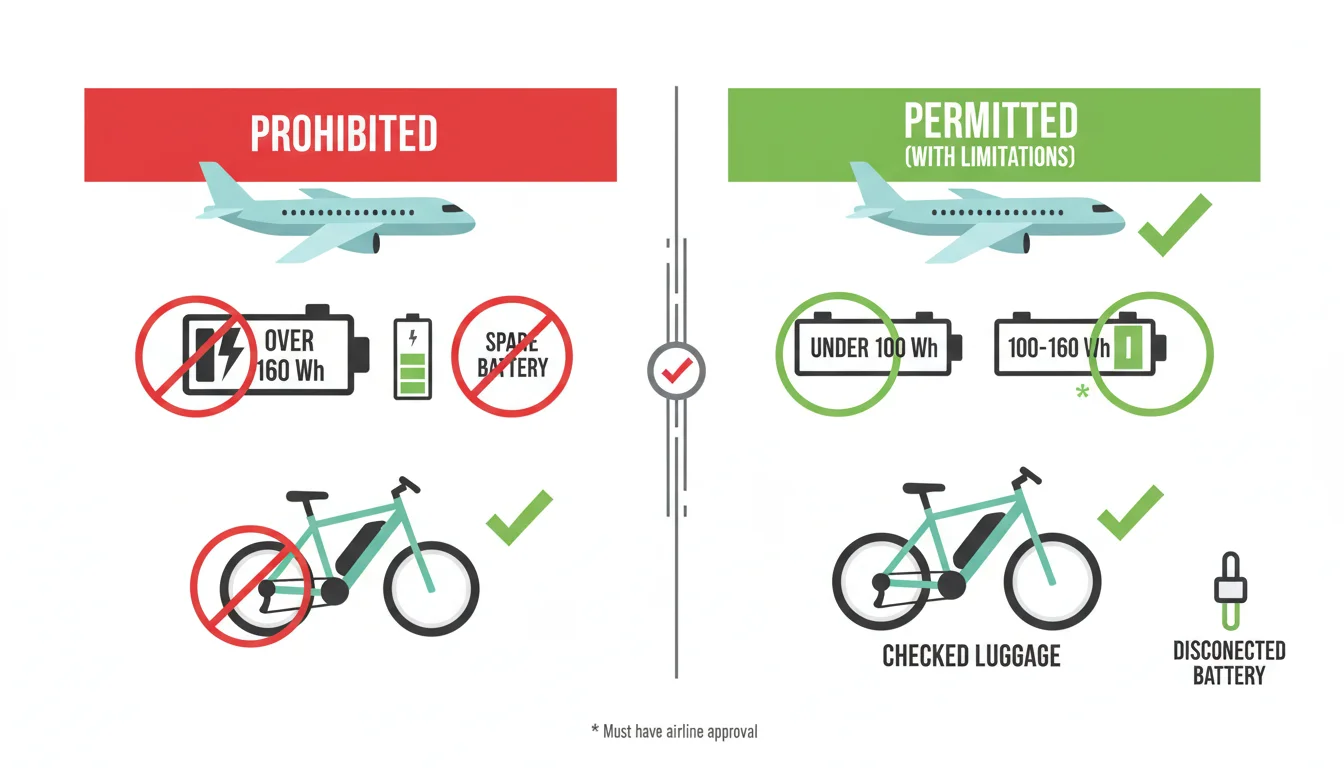
Batteries under 100 watt-hours can fly without pre-approval in carry-on luggage. Between 100Wh and 160Wh, you need airline authorization and must carry the battery in the cabin. Above 160Wh, passenger aircraft transport is prohibited entirely.
Calculate your battery's wattage with this formula: Voltage × Amp-hours = Watt-hours.
| Battery Configuration | Calculation | Result | Allowed on Plane? |
|---|---|---|---|
| 36V × 14Ah | 36 × 14 | 504Wh | No |
| 48V × 10Ah | 48 × 10 | 480Wh | No |
| 52V × 13Ah | 52 × 13 | 676Wh | No |
| 36V × 2.5Ah (range extender) | 36 × 2.5 | 90Wh | Yes |
The 300Wh exception exists only for mobility devices like electric wheelchairs. Airlines require medical documentation and advance approval for these exceptions. Ebikes do not qualify as mobility devices under current regulations, so this workaround does not apply.
Some external range-extender batteries fit in a water bottle cage and stay under 100Wh. These compact units represent your only realistic option for flying with any ebike battery. BikeRadar notes this solution works for riders willing to sacrifice range for portability.
Airline Policies: Who Allows What in 2026
Every major US carrier prohibits ebike batteries regardless of size. Delta, United, American, Southwest, JetBlue, and Spirit all enforce blanket bans on ebike battery transport in both checked and carry-on luggage.
| Airline | Ebike Battery Policy | Frame Without Battery | Special Exceptions |
|---|---|---|---|
| Delta | Prohibited | Allowed as oversized baggage | None for ebikes |
| United | Prohibited | Allowed as oversized baggage | None for ebikes |
| American | Prohibited | Allowed as oversized baggage | None for ebikes |
| Southwest | Prohibited | Allowed as oversized baggage | None for ebikes |
| British Airways | Prohibited | Allowed as oversized baggage | None for ebikes |
| EasyJet | Prohibited | Allowed as oversized baggage | None for ebikes |
International carriers follow identical IATA guidelines. British Airways, EasyJet, and Lufthansa enforce the same restrictions as US airlines.
Policies shift frequently. Always contact your airline directly within 48 hours of your flight to confirm current rules. Xnito recommends getting written confirmation via email for documentation purposes.
The frame-only approach works reliably. Pack your ebike without the battery, and airlines treat it like any other bicycle. Oversized baggage fees typically run $150-200 each way.
TSA and FAA Rules for US Travelers
The TSA follows FAA hazardous materials guidelines, which align with international IATA standards. All three regulatory bodies agree on the 160Wh maximum for lithium batteries on passenger aircraft.
- Batteries over 160Wh are banned from both checked and carry-on luggage
- Spare batteries must travel in carry-on bags, never checked
- Battery terminals require protection against short circuits using tape or plastic caps
- Damaged or recalled batteries are completely prohibited
- Airlines limit passengers to two spare batteries between 100-160Wh
Declare your batteries at security screening even when they comply with size limits. TSA agents appreciate transparency, and doing so speeds up the inspection process. Keep your battery specifications visible on the label or bring documentation showing the Wh rating.
The FAA enforces these rules strictly because lithium fires at 35,000 feet create catastrophic risks. EVELO cites FAA warnings that lithium batteries "can catch fire if damaged or if battery terminals are short-circuited."
Practical Solutions for Traveling With Your Ebike
Ship your battery via ground freight while flying with the frame. UPS and FedEx Ground accept lithium batteries with proper hazardous materials packaging and labeling.
| Solution | Estimated Cost | Complexity | Best For |
|---|---|---|---|
| Ground ship battery + fly frame | $100-300 shipping + $150-200 baggage | Medium | Extended trips |
| Rent ebike at destination | $50-150/day | Low | Short trips |
| Buy compatible battery there | $300-800 | Medium | Permanent relocation |
| Specialized ebike shipping service | $400-600 total | Low | Full bike transport |
| Folding ebike with small battery | Flight cost only | High | Frequent travelers |
Renting at your destination often makes the most financial sense for trips under two weeks. Major tourist cities now have robust ebike rental networks with quality bikes available.
Specialized shipping companies like BikeFlights handle hazmat compliance paperwork for you. The premium price buys convenience and peace of mind. [Shimano Lifestyle] confirms that ebike manufacturers regularly use these services for customer deliveries.
Some folding ebikes feature swappable 90Wh range extenders that comply with carry-on rules. You sacrifice range but gain genuine air travel capability.
How to Pack Your Ebike Frame for Air Travel
Remove the battery, pedals, handlebars, and front wheel before packing. Turn the handlebars 90 degrees and secure them parallel to the frame using zip ties or velcro straps.
- Use a padded bike travel bag or hard-shell case rated for air travel
- Wrap the derailleur in bubble wrap and attach a derailleur guard
- Insert foam spacers in the fork dropouts and rear triangle
- Deflate tires to 50% pressure to prevent blowouts from cabin pressure changes
- Protect disc brake rotors with cardboard shields
- Remove the rear derailleur entirely if your case lacks sufficient clearance
Photograph your bike from multiple angles before packing. Document the condition of paint, components, and any existing scratches. These photos protect you during damage claims.
Check your airline's oversized baggage dimensions and weight limits. Most airlines cap bike boxes at 50-70 pounds with linear dimensions under 115 inches total. Fees range from $150-200 domestically and $200-300 internationally.
FAQ
Do any airlines allow ebike batteries over 160Wh?
No major commercial airline permits ebike batteries exceeding 160Wh on passenger flights. This restriction applies globally across US, European, and Asian carriers. Cargo-only aircraft offer the sole exception through hazmat shipping services.
What happens if I try to bring an ebike battery through security?
TSA will confiscate batteries exceeding limits and may issue fines. Attempting to hide batteries in checked luggage creates serious legal consequences. Being upfront at screening protects you from penalties.
Are there ebikes designed specifically for air travel?
Several folding ebike models feature removable range-extender batteries under 100Wh. Brands like GoCycle and Brompton Electric offer compact designs with airline-friendly power options, though range drops significantly with smaller batteries.
How long does ground shipping an ebike battery take?
Ground freight typically requires 5-10 business days depending on distance. Plan your battery shipment at least two weeks before your travel date. Hazmat processing adds time compared to standard packages.
Do I need special packaging to ship an ebike battery?
Yes. Lithium batteries require UN-certified packaging with hazmat labels for ground transport. Many ebike retailers sell compliant battery shipping boxes. Improper packaging results in shipment refusal.
Will travel insurance cover my ebike during flights?
Standard travel insurance rarely covers ebike damage adequately. Specialized bicycle travel insurance from providers like Velosurance offers better protection. Review policy exclusions carefully before purchasing.
Are train companies more accommodating than airlines?
Amtrak and European rail services generally accept ebikes with batteries intact. Size and weight restrictions vary by carrier and route. Train travel offers a practical alternative for regional trips.
What voltage and amp-hour combination stays under 100Wh?
A 36V battery must stay under 2.8Ah to remain below 100Wh. A 48V battery must stay under 2.1Ah. These capacities provide roughly 10-15 miles of range depending on terrain and assist level.
Share this post
Related Posts
Why Is My Ebike Throttle Not Working? 8 Common Causes and Fixes
Why Is My Ebike Throttle Not Working? 8 Common Causes and Fixes
Can E-Bikes Be Ridden in the Rain? Complete Guide to Wet Weather Riding in 2026
Can E-Bikes Be Ridden in the Rain? Complete Guide to Wet Weather Riding in 2026
Do You Need a Driver's License for an E-Bike? 2026 State-by-State Guide
Do You Need a Driver's License for an E-Bike? 2026 State-by-State Guide