Do Ebikes Have Regenerative Braking? The Complete 2026 Guide
Some ebikes have regenerative braking, but most don't. The technology recovers only 5-10% of braking energy on bicycles compared to 15-30% on heavier electric cars. This guide covers how regen works, which bikes offer it, and whether the premium price makes sense for your riding style.
What Is Regenerative Braking and How Does It Work on Ebikes?
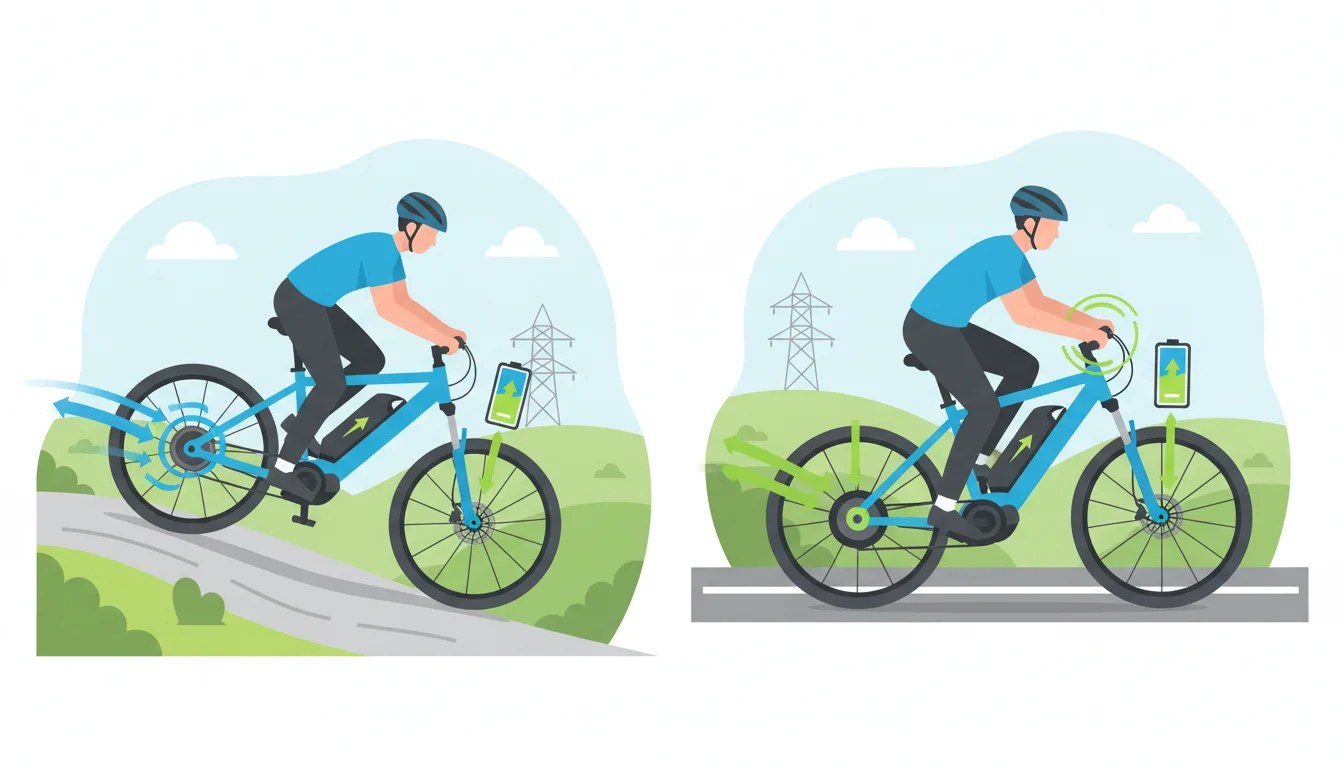
Regenerative braking systems convert your forward motion into electricity when you slow down. The motor switches into generator mode during braking, spinning backward to produce current that flows directly into your battery.
The physics are straightforward. Your momentum turns the motor's magnets past copper coils, generating voltage. This creates resistance that helps slow the bike while capturing energy that would otherwise become heat in your brake pads.
| Factor | Ebikes | Electric Cars |
|---|---|---|
| Typical Energy Recovery | 5-10% | 15-30% |
| Vehicle Weight | 50-80 lbs | 4,000-6,000 lbs |
| Kinetic Energy Available | Low | High |
| Braking Frequency | High (stop-and-go) | Lower (highway cruising) |
| Motor Type Required | Direct-drive hub only | Any electric motor |
The weight difference explains everything. A 200-pound rider on a 60-pound ebike generates far less kinetic energy than a 5,000-pound Tesla. Less energy in motion means less energy to recover. [iManager Publications] found that regenerative braking efficiency on ebikes averages 9.05% with respect to speed.
Why Most Ebikes Don't Have Regenerative Braking
Motor architecture eliminates this feature from most bikes before manufacturers even consider adding it. Regenerative braking requires direct-drive hub motors. Geared hub motors and mid-drive systems cannot perform regen due to their mechanical design.
Here's why regen remains rare:
- Motor compatibility: Only direct-drive hub motors support regeneration. Mid-drives and geared hubs use freewheel mechanisms that prevent backward energy flow.
- Weight penalty: Direct-drive motors weigh 4-6 kg versus 2-3 kg for geared hubs. That extra weight reduces range more than regen recovers.
- Drag problem: Direct-drive motors create resistance when pedaling without assist. You feel like you're pushing through mud on flat ground.
- Controller complexity: Regen requires sophisticated battery management systems that add $200-400 to manufacturing costs.
- Limited payoff: Most urban commuters ride flat terrain with frequent stops—conditions that produce the worst regen efficiency.
The cost-benefit math rarely works out. Adding 3-4 pounds to capture 5-10% energy makes sense for mountain descents. It makes zero sense for flat bike paths. EVELO explains that the added weight often offsets any range gains from energy recovery.
Pros and Cons of Regenerative Braking on Ebikes
The benefits shine in specific scenarios while the drawbacks affect every ride. Your terrain and riding style determine whether regen adds value or subtracts from it.
Advantages:
- Extended range of 5-15% in hilly conditions with long descents
- Brake pad life increases 30-50% due to reduced friction braking
- Smoother deceleration and greater control on steep downhills
- Lower long-term maintenance costs from reduced brake wear
- Environmental benefit of recapturing otherwise wasted energy
Disadvantages:
- Heavier motor weight (2-3 kg extra) reduces overall efficiency
- Higher purchase price of $200-400 above comparable non-regen bikes
- Motor drag when pedaling without assist feels sluggish
- Minimal benefit on flat terrain where most people ride
- Unnatural feel that prevents free coasting downhill
[GOAT Power Bikes] notes that riders in San Francisco love regen, while riders in Florida wonder why they paid extra for it. Your zip code matters more than the technology specs.
Real-World Efficiency: How Much Range Does Regen Actually Add?
Expect 5-10% energy recovery under normal riding conditions. That translates to 3-7 extra miles on a 50-mile ride with 2,000 feet of elevation change. The gains depend entirely on your braking opportunities.
| Terrain Type | Energy Recovery | Range Extension | Worth the Premium? |
|---|---|---|---|
| Steep mountain descents | 10-15% | 5-8 miles per 50 | Yes |
| Rolling hills | 7-10% | 3-5 miles per 50 | Maybe |
| Mixed urban/suburban | 5-8% | 2-4 miles per 50 | Probably not |
| Flat terrain | 3-5% | 1-2 miles per 50 | No |
Speed matters significantly. [iManager Publications] shows that voltage generation increases at higher speeds, making regen more efficient during fast descents than slow urban braking. Efficiency doubles in sloped areas compared to flat ground.
Let's be honest: regen won't eliminate your charging routine. It won't double your range. It adds incremental benefit that compounds over thousands of miles. Think of it like a 7% raise—nice to have, but not life-changing.
Ebikes With Regenerative Braking: Top Models in 2026
Several manufacturers build sophisticated regen systems into their premium lineups. Availability and specifications change frequently, so verify current features before purchasing.
| Brand/Model | Price Range | Regen Levels | Motor Type | Best For |
|---|---|---|---|---|
| Stromer ST5 | $5,500-7,000 | 4 adjustable | Direct-drive hub | Long-distance commuters |
| Stromer ST3 | $4,500-5,500 | 3 adjustable | Direct-drive hub | Urban professionals |
| Specialized Turbo Vado | $3,500-5,000 | 2 levels | Direct-drive hub | Mixed terrain riders |
| GOAT Dirt Goat 96V | $4,000-5,500 | 4 customizable | Direct-drive hub | Off-road enthusiasts |
| Rad Power RadCity | $1,500-2,000 | Basic | Direct-drive hub | Budget-conscious buyers |
Stromer's Swiss engineering leads the category. Their app lets you fine-tune regen intensity for different routes. You can save an aggressive setting for your morning descent and a lighter one for flat afternoon errands.
VanMoof offered excellent regen before their 2023 bankruptcy. The brand relaunched under new ownership, but verify that current models include this feature. [MacFox Bike] covers emerging options as manufacturers experiment with the technology.
Should You Buy an Ebike With Regenerative Braking?
Your daily route determines whether regen delivers value or wastes money. The technology excels in narrow circumstances and disappoints everywhere else.
Regen makes sense if you:
- Live in hilly terrain with descents over half a mile
- Commute 20+ miles daily where 5-10% gains compound
- Prioritize brake maintenance savings over upfront cost
- Want smoother speed control on steep downhills
Skip regen if you:
- Ride mostly flat terrain like bike paths or beach routes
- Have a budget under $2,500 for your ebike
- Care about bike weight for carrying or storage
- Prefer the natural feel of coasting without resistance
Fair warning: that $300-500 regen premium could buy significant battery capacity instead. A larger battery guarantees extra range. Regen only promises it under ideal conditions. For most riders, the bigger battery wins.
FAQ
Does regenerative braking work while coasting downhill?
No. Regen activates only during active braking when you squeeze the brake levers. Coasting downhill without braking produces no energy recovery on standard direct-drive systems.
Can I add regenerative braking to my existing ebike?
Only if your bike already has a direct-drive hub motor. You cannot add regen to geared hub motors or mid-drive systems. The conversion requires compatible controllers and costs $300-600 for parts alone.
How does weather affect regenerative braking efficiency?
Cold temperatures reduce battery acceptance of regenerative charge by 10-20%. Wet conditions don't affect the motor but require more aggressive braking overall, which slightly increases regen opportunities.
Will regenerative braking stop my bike completely?
No. Regen provides supplementary braking force but cannot stop you on its own. All regen-equipped ebikes include mechanical disc brakes for full stopping power and safety.
Does regenerative braking make noise?
Most systems produce a slight whirring sound during heavy regen. The noise increases with braking intensity. Some riders find it helpful as audible feedback, while others find it mildly annoying.
How long do direct-drive hub motors last compared to geared motors?
Direct-drive motors often outlast geared versions because they have no internal gears to wear out. Expect 10,000-20,000 miles from direct-drive motors versus 5,000-15,000 from geared hub motors with proper maintenance.
Can regenerative braking overcharge my battery?
Modern battery management systems prevent overcharging. If your battery reaches full capacity, the regen system automatically reduces or stops energy recovery to protect battery health.
Share this post
Related Posts
Why Is My Ebike Throttle Not Working? 8 Common Causes and Fixes
Why Is My Ebike Throttle Not Working? 8 Common Causes and Fixes
Can E-Bikes Be Ridden in the Rain? Complete Guide to Wet Weather Riding in 2026
Can E-Bikes Be Ridden in the Rain? Complete Guide to Wet Weather Riding in 2026
Do You Need a Driver's License for an E-Bike? 2026 State-by-State Guide
Do You Need a Driver's License for an E-Bike? 2026 State-by-State Guide