When Is an Ebike a Moped? Understanding the Legal Line in 2026
Electric bikes outsell electric cars in the United States, yet most riders don't know where the legal line falls between an ebike and a moped. Federal law sets clear thresholds at 750 watts and 20-28 mph—exceed them, and your bike transforms into a motor vehicle overnight. This guide breaks down the power limits, state variations, and documentation you need to stay legal in 2026.
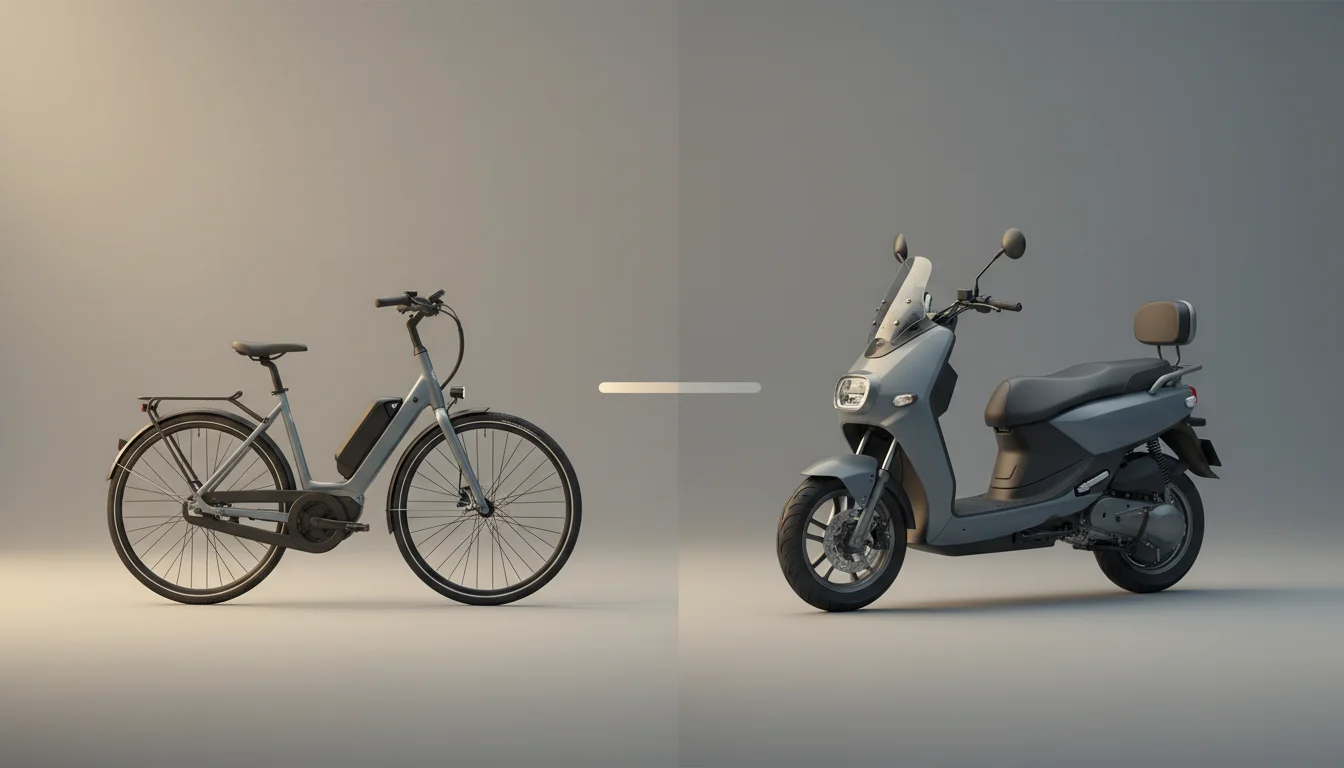
The Key Differences Between Ebikes and Mopeds
The core distinction comes down to one question: does your vehicle require pedaling to move? Ebikes need rider input to activate motor assistance, while mopeds operate on motor power alone without any pedaling requirement.
Physical and functional differences:
- Ebikes use pedal-assist systems that engage only when you pedal, or have throttles limited to 20 mph
- Mopeds feature larger frames, motorcycle-style step-through seating, and motors designed for independent operation
- Ebikes are classified as bicycles under federal law
- Mopeds are classified as motor vehicles requiring registration and licensing
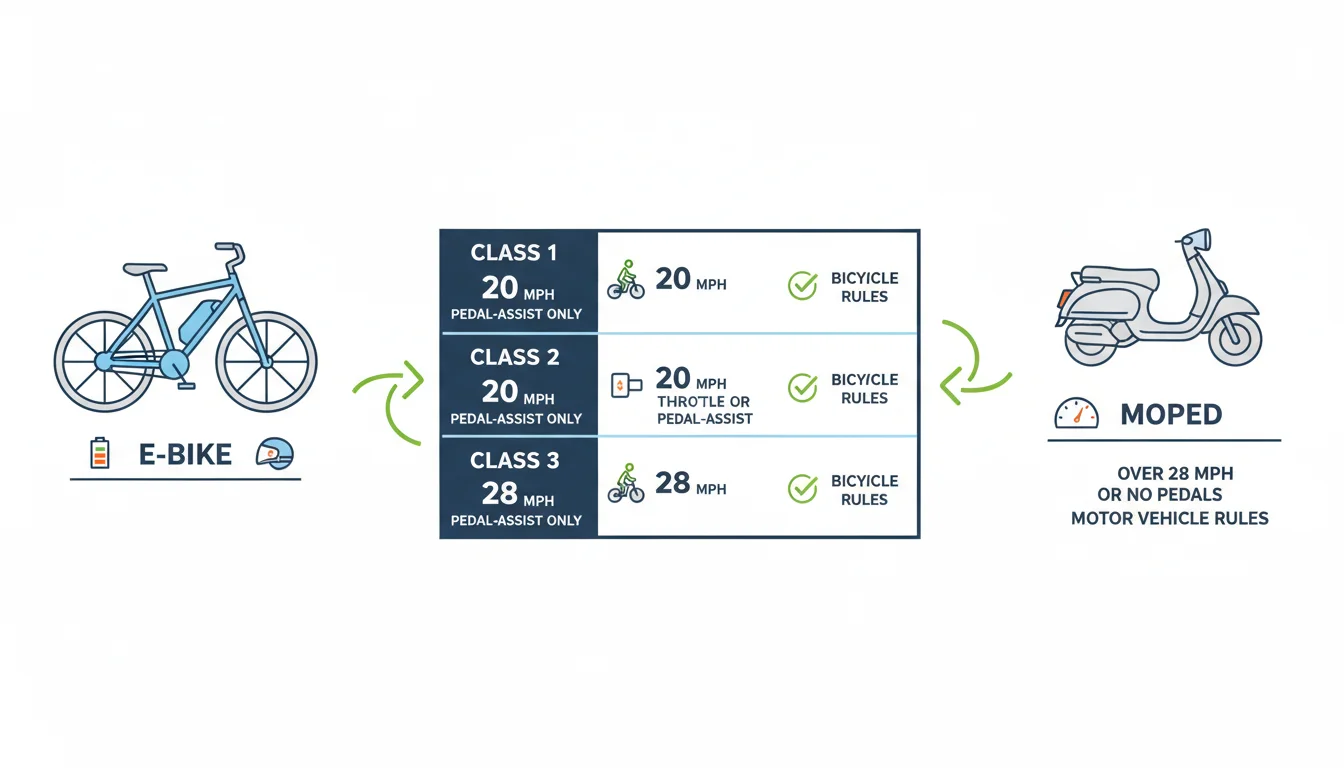
The pedal-assist versus throttle debate matters here. Class 1 and Class 3 ebikes provide assistance only when you're actively pedaling. Class 2 ebikes include a throttle but cap motor-only speed at 20 mph. The moment a vehicle exceeds these parameters or eliminates the pedaling requirement entirely, different electric bike vs moped laws apply.
When is an ebike a moped? Your two-wheeler crosses the line when it operates independently of pedaling beyond legal speed thresholds, or when motor power exceeds 750 watts. This isn't about how your bike looks—it's about what your bike does.
Power and Speed Thresholds That Define Classification
Federal law draws the line at 750 watts of motor power and 20 mph for throttle operation, with pedal-assist systems permitted up to 28 mph. Cross either threshold, and your ebike becomes a moped or motorcycle under federal statute.
| Class | Motor Assistance Type | Maximum Speed | Throttle Allowed |
|---|---|---|---|
| Class 1 | Pedal-assist only | 20 mph | No |
| Class 2 | Pedal-assist + throttle | 20 mph | Yes |
| Class 3 | Pedal-assist only | 28 mph | No |
The ebike power limit of 750W applies across all three classes. This is where the EU standard creates confusion for imported bikes. European regulations cap motors at 250 watts and 25 km/h (about 15.5 mph), so a bike legal in Germany might still qualify as an ebike in California but face different restrictions.
Here's what trips up most riders: the 250W ebike limit you see referenced online applies to European markets, not U.S. federal law. American riders get three times that wattage before hitting moped classification requirements.
Speed capability matters even when you're cruising slowly. A bike designed to hit 35 mph under motor power is legally a moped regardless of your actual riding speed. The National Conference of State Legislatures confirms that exceeding designed speed or motor limits automatically triggers registration, licensing, and insurance requirements.
State-by-State Legal Variations in 2026
Most states follow the federal three-class system, but 14 states have modified definitions that change where your ebike sits legally. What's street legal in Texas might require registration in New York.
| State | Classification System | Class 3 Registration | Minimum Age (Class 3) | Bike Path Access |
|---|---|---|---|---|
| California | Three-class | No | 16 | Class 1 & 2 only |
| New York | Three-class (modified) | No | 16 | Class 1 only |
| Texas | Three-class | No | None | All classes |
| Florida | Three-class | No | 16 | Class 1 & 2 only |
| New Jersey | Modified definition | Varies | 15 | Restricted |
California recently clarified that Class 3 ebikes cannot include a throttle alongside their 28 mph pedal-assist capability. This matters if you're shopping for a faster commuter bike. New York restricts bike path access to Class 1 ebikes only, pushing Class 2 and Class 3 riders onto roads.
Ebike legal regulations depend on where you plan to ride, not where you bought your bike. The question "is my ebike street legal" has a different answer in each state. Ebike licensing by state varies as well—some states require Class 3 riders to be 16 or older, while Texas has no age restriction at all.
Before your next ride in a new state, check the eBike Generation state law database for current regulations. Laws changed in 12 states during 2024 alone.
The Gray Area: Moped-Style Ebikes
A moped-style ebike that meets the 750W and 20 mph thresholds is legally an ebike regardless of its appearance. Police officers don't classify your vehicle by how it looks—they classify it by the specifications printed on the motor.
Why appearance doesn't determine classification:
- A step-through frame with motorcycle styling is still an ebike if specs comply
- Fat tires, front suspension, and bench seats don't change legal status
- The manufacturer's specification label serves as your legal classification document
- Exceeding 750W or speed limits pushes any design into moped territory
The enforcement challenge is real. Officers regularly stop moped-style ebike riders for inspection because visual identification is impossible. You'll save yourself roadside hassle by carrying documentation that proves your vehicle's classification.
Documents to keep with your bike:
- Manufacturer specification sheet showing motor wattage
- Proof of maximum motor-assisted speed
- Copy of the ebike class label (required to be visible in some states)
- Purchase receipt showing model specifications
I learned this the hard way after getting stopped twice in one month on a Rad Power bike. The officer had no way to verify my 750W motor without documentation. Now I keep specs in my phone case. Hovsco recommends laminating a copy of your spec sheet for weatherproofing.
License, Registration, and Insurance Requirements
Ebikes require no license, registration, or insurance in most states. Mopeds require all three, plus helmet compliance in many jurisdictions.
Ebike requirements (all classes):
- No driver's license needed
- No registration or plates
- No mandatory insurance
- Helmet laws vary by state and age
Moped requirements (typical):
- Valid driver's license (some states require motorcycle endorsement)
- Vehicle registration and plates
- Liability insurance
- Helmet required in most states
The cost difference adds up fast. Moped registration runs $15-75 annually depending on your state. Liability insurance starts around $200 per year for basic coverage. A single ticket for riding an unregistered moped can reach $500 in fines.
Some riders voluntarily insure their ebikes despite no legal requirement. Standard homeowner's policies often exclude ebikes from coverage, leaving you exposed if you cause an accident. Electric bike vs moped laws create different liability exposure as well. Ebike accidents typically fall under bicycle negligence standards, while moped accidents follow motor vehicle liability rules with higher damage thresholds.
Ebike registration requirements exist in a few states for Class 3 bikes. Check with your local DMV before assuming you're exempt from paperwork.
How to Determine Your Vehicle's Classification
Start with four specifications: motor wattage, maximum motor-assisted speed, throttle capability, and pedal requirement. These four numbers tell you exactly where your vehicle sits legally.
Classification checklist:
- Find motor wattage on the motor housing label or manufacturer specs
- Check maximum speed rating in the owner's manual or spec sheet
- Confirm whether the throttle operates without pedaling
- Verify pedals are fully functional (federal requirement for ebike status)
If your motor shows 750W or less, your throttle-only speed caps at 20 mph, and pedals work, you have an ebike. Anything beyond these limits means moped classification requirements apply.
What to do if your ebike has been modified:
- Aftermarket controllers that increase speed void your ebike classification
- Motor swaps above 750W require moped registration
- Removing the speed limiter makes your bike a moped legally
- Some modifications are reversible if you need to restore ebike status
When specs are unclear or your bike sits right at the threshold, consult your local DMV for a written determination. This documentation protects you if you're stopped. The question "when is an ebike a moped" has a technical answer, and getting it in writing from authorities beats arguing on the roadside.
FAQ
Do I need a license to ride a Class 3 ebike?
No license is required for Class 3 ebikes in most states. Age restrictions typically require riders to be 16 or older. Check your specific state requirements since regulations vary.
Can I ride my ebike on bike paths?
Class 1 ebikes are permitted on bike paths in most states. Class 2 and Class 3 ebikes face restrictions on many trails and paths. Local jurisdictions often set their own rules beyond state law.
What happens if I modify my ebike to go faster?
Modifications that increase speed beyond class thresholds reclassify your ebike as a moped. You'll need registration, insurance, and potentially a license. Riding a modified ebike as if it's still an ebike can result in fines.
Does my homeowner's insurance cover ebike accidents?
Most homeowner's policies exclude ebikes from liability coverage. Contact your insurance provider to confirm your specific policy. Dedicated ebike insurance policies start around $100 annually.
Are throttle-only ebikes legal?
Class 2 ebikes with throttle capability are legal when limited to 20 mph. Throttles that operate beyond 20 mph without pedaling push the vehicle into moped classification. The pedals must remain functional even if you primarily use the throttle.
What's the penalty for riding a moped without registration?
Fines range from $100 to $500 depending on your state. Repeat offenses can result in vehicle impoundment. Some states add points to your driving record for operating an unregistered motor vehicle.
Can I convert my moped-class vehicle back to an ebike?
Yes, if you reduce motor power to 750W or below and limit speed to legal thresholds. You'll need documentation of the changes. Some riders install programmable controllers that switch between modes for different jurisdictions.
Share this post
Related Posts
Why Is My Ebike Throttle Not Working? 8 Common Causes and Fixes
Why Is My Ebike Throttle Not Working? 8 Common Causes and Fixes
Can E-Bikes Be Ridden in the Rain? Complete Guide to Wet Weather Riding in 2026
Can E-Bikes Be Ridden in the Rain? Complete Guide to Wet Weather Riding in 2026
Do You Need a Driver's License for an E-Bike? 2026 State-by-State Guide
Do You Need a Driver's License for an E-Bike? 2026 State-by-State Guide