When Is an E-Bike a Motorcycle? Legal Limits, Wattage Thresholds & 2026 Regulations
When is an e-bike a motorcycle? The answer hinges on three legal thresholds: motor power, top speed, and whether pedaling is required. In the US, exceeding 750 watts or 28 mph triggers motorcycle classification. This guide breaks down the exact limits across major jurisdictions so you can stay legal on your next ride.
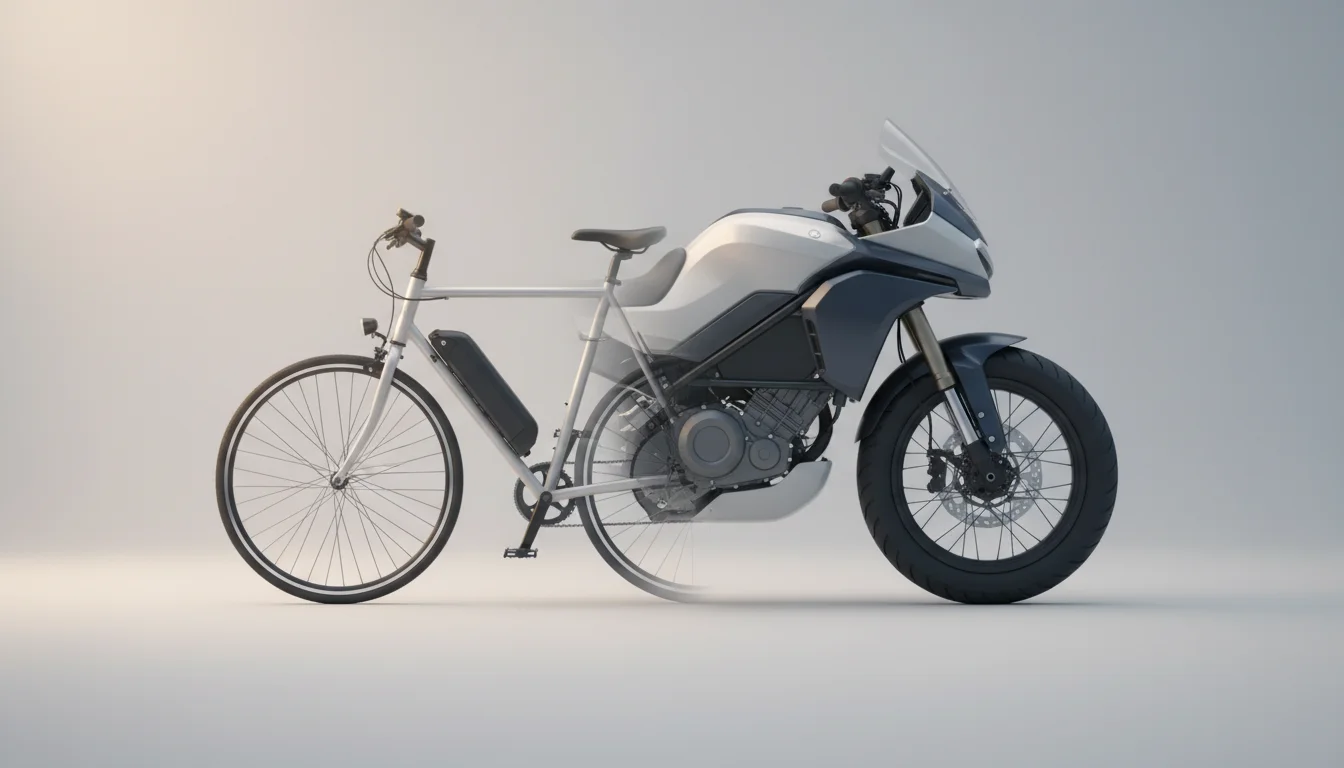
Motor Power Limits: The 750W Threshold Explained
US federal law caps e-bike motors at 750 watts of continuous rated power. Cross that line, and your two-wheeler becomes a moped or motorcycle in the eyes of the law.
The European Union takes a stricter approach, setting the maximum at 250 watts. This EAPC (Electrically Assisted Pedal Cycle) standard also requires motor cutoff at 25 km/h and pedaling to activate assistance.
| Region | Motor Power Limit | Speed Limit | Assist Type | Exceeding Limits |
|---|---|---|---|---|
| United States | 750W (1 HP) | Varies by state | Pedal-assist or throttle | Moped/motorcycle registration required |
| European Union | 250W | 25 km/h (15.5 mph) | Pedal-assist only | Moped/motorcycle licensing required |
| United Kingdom | 250W | 25 km/h (15.5 mph) | Pedal-assist only | Motor vehicle registration required |
Here's where riders get tripped up: peak power versus continuous rated power. Your motor might spike to 1,000 watts climbing a hill, and that's perfectly fine. Laws target the sustainable output your motor delivers over time, not momentary bursts.
The EN15194:2017 standard codifies these EU limits and serves as the benchmark for market access across Europe. In the US, the Consumer Product Safety Commission defines the 750W federal baseline, but individual states add their own requirements. [Velotric E-Bike Laws Guide] provides state-specific breakdowns.
Speed-Based Classifications: When Going Faster Changes Everything
Motor-assisted speed determines your e-bike's legal class in the US. The three-class system creates clear boundaries between bicycle and motor vehicle territory.
| Class | Pedaling Required | Throttle Allowed | Max Assisted Speed | Typical Restrictions |
|---|---|---|---|---|
| Class 1 | Yes | No | 20 mph (32 km/h) | Allowed on most bike paths |
| Class 2 | No | Yes | 20 mph (32 km/h) | Some trail restrictions |
| Class 3 | Yes | Limited | 28 mph (45 km/h) | Often requires minimum age, helmet |
Push past 28 mph with motor assistance, and you've entered motorcycle territory. Some states set the threshold even lower—California treats anything exceeding 28 mph as outside e-bike classification entirely.
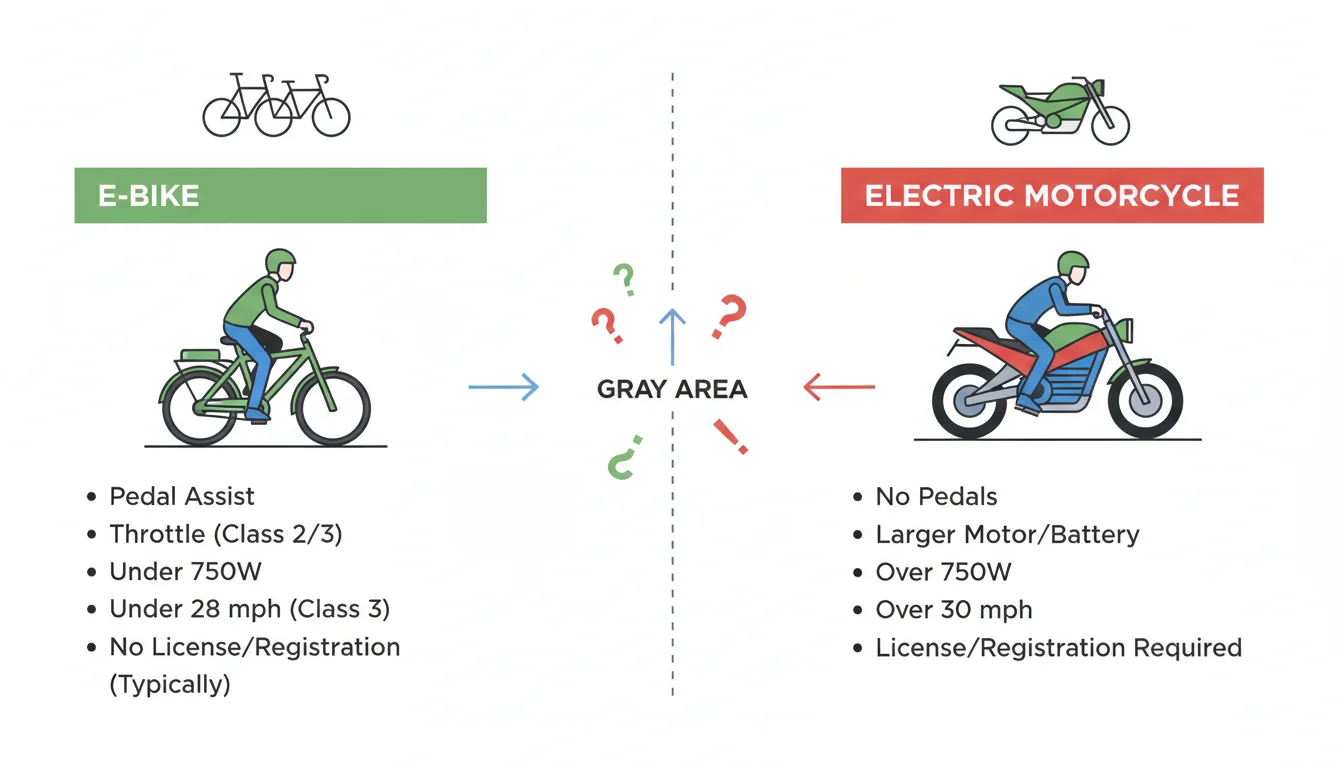
Thirty-six states now use this three-class framework. The remaining states apply their own definitions, but the core principle holds: exceed the speed ceiling, and you lose your bicycle status. Check BikeBerry's State-by-State Breakdown before assuming your Class 3 is street-legal everywhere.
Throttle vs. Pedal-Assist: A Critical Legal Distinction
Pedal-assist keeps you in bicycle territory because the motor only engages when you're actively pedaling. Throttle-only operation at higher speeds pushes your ride toward motorcycle classification.
The EU draws a hard line here. EAPC standards require pedaling to activate motor assistance—no pedaling, no motor, period. The UK follows suit, allowing throttle-only operation up to a walking pace of 6 km/h (3.7 mph) and nothing more.
US regulations offer more flexibility. Class 2 e-bikes permit throttle-only propulsion up to 20 mph while retaining bicycle status. Go faster on throttle alone, and you're looking at registration requirements in most states.
This distinction matters more than wattage for many riders. I've seen people install powerful hub motors within legal limits, then lose their e-bike classification because they added an unrestricted throttle. [Juiced Bikes] explains how throttle configuration affects your legal standing.
International Regulations: US, UK, EU, Canada & Australia Compared
Each country draws its own line between e-bike and motorcycle. What's legal in Los Angeles might require a license plate in London.
| Country | Max Power | Speed Limit | Throttle Rules | Key Requirement |
|---|---|---|---|---|
| United States | 750W | 20-28 mph (class dependent) | Allowed within limits | Federal + state laws apply |
| European Union | 250W | 25 km/h (15.5 mph) | Not permitted | Pedaling required (EAPC) |
| United Kingdom | 250W | 25 km/h (15.5 mph) | Limited to 6 km/h | EAPC compliance mandatory |
| Canada | 500W | 32 km/h (20 mph) | Permitted | Provincial variations |
| Australia | 250W pedal / 200W throttle | 25 km/h (15.5 mph) | Power-restricted | State-by-state differences |
Canada sits between US and EU standards at 500 watts and 32 km/h. Australian rules get complicated, with different wattage limits for pedal-assist versus throttle operation.
Fair warning: these are federal or national baselines. Provincial, state, and local regulations add layers of complexity. A bike legal in Queensland might face restrictions in Victoria. Your compliant ride in Texas could violate California trail access rules.
Registration, Licensing & Insurance: What Changes When Your E-Bike Becomes a Motorcycle
Crossing into motorcycle territory triggers a cascade of new requirements. Your simple bike path commuter transforms into a registered motor vehicle.
- DMV registration: License plates, annual fees, and VIN documentation become mandatory
- License requirements: Most jurisdictions require an M1 or M2 motorcycle endorsement
- Insurance: Liability coverage shifts from optional to legally required
- Safety equipment: DOT-approved helmets, mirrors, turn signals, and proper lighting
- Road access: Bike paths, multi-use trails, and cycle lanes become off-limits
The insurance piece catches many riders off guard. E-bike accidents on a non-compliant vehicle give insurers grounds to deny claims entirely. Damon Motorcycles details the licensing differences between e-bikes and electric motorcycles.
These requirements exist for good reason. A 2,000-watt bike hitting 35 mph shares more DNA with a motorcycle than a bicycle.
Modifications That Cross the Line: Common Mistakes to Avoid
Aftermarket upgrades turn legal e-bikes into unregistered motorcycles faster than most riders realize.
- Controller swaps: Replacing the stock controller to unlock higher wattage voids your e-bike classification instantly
- Speed limiter removal: Bypassing the 20 or 28 mph cutoff is illegal and reclassifies your vehicle
- Throttle additions: Adding throttle capability to pedal-assist-only bikes violates regulations in the EU, UK, and some US states
- Battery upgrades: Higher voltage systems that increase motor output beyond legal limits
Legal consequences extend beyond traffic tickets. Vehicle impoundment, voided manufacturer warranties, and personal liability in accidents all come into play. If you crash a modified e-bike that's technically an unregistered motorcycle, your homeowner's insurance won't cover the damages.
I learned this while researching a controller upgrade for my own ride. The performance gains simply weren't worth losing trail access and taking on uninsured liability risk.
FAQ
Does removing the speed limiter make my e-bike a motorcycle?
Yes, in most jurisdictions. Speed limiters exist specifically to maintain e-bike classification. Removing or bypassing them pushes your bike above the legal speed threshold, triggering motorcycle registration requirements.
Do I need a license for a 1000W e-bike in the US?
A 1000W motor exceeds the 750W federal limit for e-bikes. You'll need motorcycle registration and likely a motorcycle license or endorsement, though specific requirements vary by state.
Are e-bikes with throttles legal in Europe?
Standard throttle operation is not permitted under EU EAPC regulations. The UK allows throttle assist up to 6 km/h only. Higher-speed throttle operation requires moped or motorcycle classification.
What happens if I ride an illegal e-bike?
Penalties include fines, vehicle impoundment, and potential criminal charges for operating an unregistered motor vehicle. Insurance claims from accidents will likely be denied, and repeat violations lead to escalating consequences.
Do e-bike laws differ between states?
Significantly. While 36 states use the three-class system, definitions of each class, age requirements, helmet mandates, and trail access rules vary widely. Always verify local regulations before riding in a new area.
Is a 750W e-bike street legal everywhere in the US?
Not automatically. While 750W meets the federal power limit, individual states impose additional restrictions on speed, throttle use, and where you can ride. Some municipalities add further limitations.
Do I need insurance for my e-bike?
Standard e-bikes within legal limits don't require insurance in most US states. Once your bike exceeds power or speed thresholds and becomes classified as a motorcycle, liability insurance becomes mandatory in nearly all jurisdictions.
Share this post
Related Posts
Why Is My Ebike Throttle Not Working? 8 Common Causes and Fixes
Why Is My Ebike Throttle Not Working? 8 Common Causes and Fixes
Can E-Bikes Be Ridden in the Rain? Complete Guide to Wet Weather Riding in 2026
Can E-Bikes Be Ridden in the Rain? Complete Guide to Wet Weather Riding in 2026
Do You Need a Driver's License for an E-Bike? 2026 State-by-State Guide
Do You Need a Driver's License for an E-Bike? 2026 State-by-State Guide