Why Is My Ebike Battery Draining So Fast? 8 Causes and How to Fix Them
E-bike batteries lose 20-30% of their original capacity after 500-1,000 charge cycles under normal conditions. If your range drops faster than 3-5% annually, something beyond normal degradation is happening. This guide covers eight causes of rapid battery drain and the fixes that will restore your riding range.
Understanding Normal vs Abnormal Battery Drain
Quality lithium-ion e-bike batteries maintain 70-80% of their original capacity through their rated cycle life of 500-1,000 full charges. This translates to 3-5 years of typical use before replacement becomes necessary.
Normal degradation follows a predictable pattern, while abnormal drain shows up quite differently.
| Timeframe | Normal Capacity Retention | Signs of Abnormal Drain |
|---|---|---|
| 6-12 months | 97-100% of original | More than 5% loss in first year |
| 1-2 years | 90-95% of original | Sudden range drops vs gradual decline |
| 2-4 years | 80-90% of original | Battery swelling or BMS faults |
| 4-6 years | 70-75% of original | Unable to complete regular commute |
Why is my ebike battery draining so fast when it's only a year old? Compare your current range against that gradual decline trajectory. Losing more than 10% in a single year, or experiencing sudden drops rather than a slow fade, points to a problem beyond normal ebike battery degradation.
Your baseline range depends on battery capacity measured in watt-hours (Wh). A 500Wh battery delivers roughly 25-50 miles depending on terrain and assist level. Track your actual range over several rides to establish whether you're experiencing abnormal ebike battery lifespan reduction. XbenBike
Riding Habits That Drain Your Battery Faster
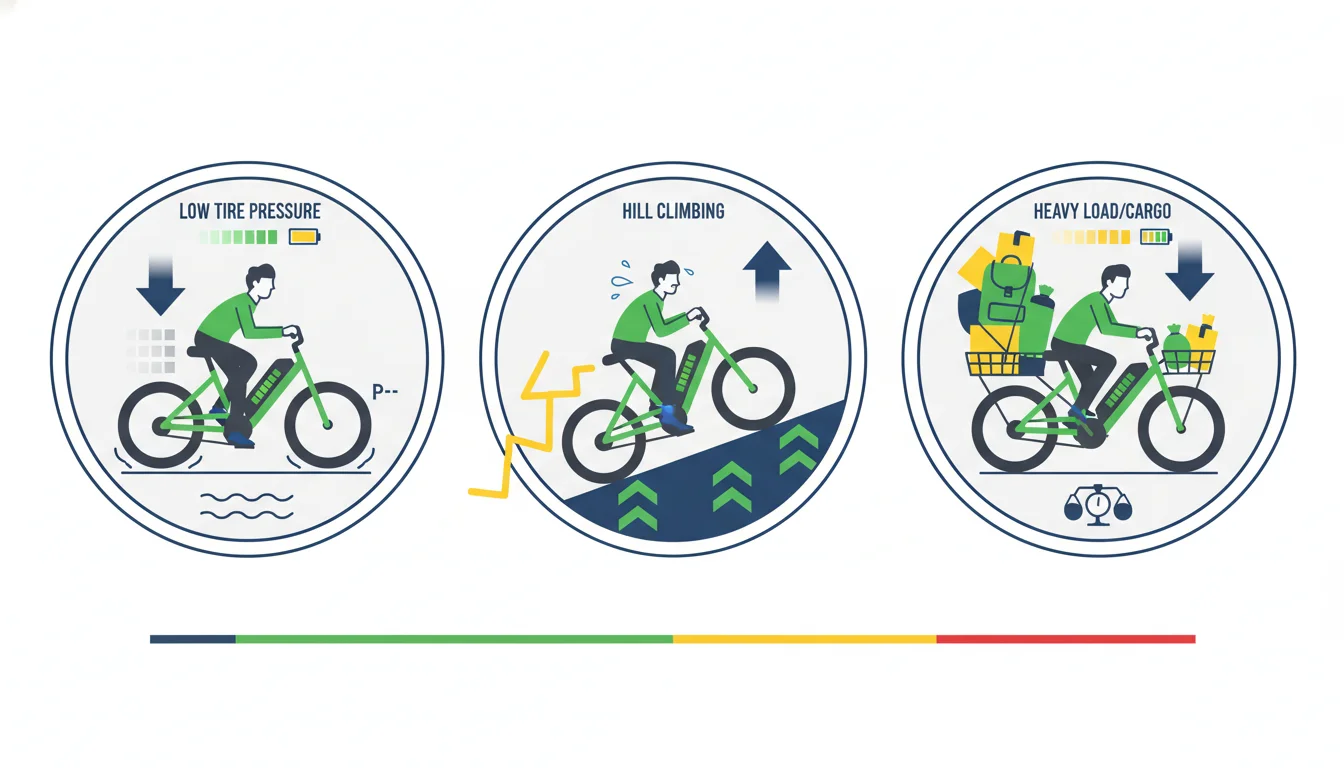
Your riding style affects battery consumption more than any other factor within your control. Throttle-only riding depletes batteries 2-3 times faster than pedal assist modes, and high-speed cruising fights exponentially increasing wind resistance.
Here's what drains your battery fastest:
- Throttle-only riding: Bypasses your pedaling contribution entirely, forcing the motor to do all the work
- High assist levels: Reserve turbo and sport modes for steep hills, not flat cruising
- Stop-and-start patterns: Each acceleration pulls peak power from your battery
- Heavy cargo: Every extra pound requires proportionally more motor output
- Off-road terrain: Thick grass and bumpy trails consume twice the power of paved paths
- Wet conditions: Expect 15% more drain on wet surfaces due to increased rolling resistance
Riders who combine lower power modes with longer routes use approximately 10% less battery compared to those pushing higher power settings for shorter distances. EMTB Forums
To improve ebike battery life through riding habits, keep tires inflated properly, choose gentler gradients when route options exist, and maintain steady speeds rather than sprinting and coasting. These adjustments alone can extend range by 15-25% for most riders dealing with ebike range problems.
Environmental Factors Affecting Battery Performance
Cold weather temporarily reduces battery capacity by 20-40% because lithium-ion chemistry slows in low temperatures. This isn't permanent damage—your range returns when the battery warms up.
Heat causes the opposite problem: it accelerates permanent degradation.
| Storage Condition | Annual Capacity Loss |
|---|---|
| 40°F (4°C) at 30% charge | ~2% |
| Room temp at 30% charge | ~5% |
| Room temp at 100% charge | ~8% |
| High temperature storage | 15-20% |
Store your battery between 50-77°F (10-25°C) for optimal ebike battery maintenance. During winter, bring your battery indoors overnight and install it just before riding. In summer, avoid leaving your e-bike in hot cars or direct sunlight.
Humidity creates a secondary issue through corrosion on electrical contacts. Inspect connection points after wet rides. A quick wipe with a dry cloth prevents the gradual buildup that causes ebike battery range issues over time. EMTB Forums
Battery Health Issues and Age-Related Decline
Lithium-ion batteries degrade through two mechanisms: calendar aging from time passing and cycle aging from charge/discharge patterns. Both reduce capacity, but your charging habits determine which dominates your ebike battery degradation rate.
Deep discharge cycles (0-100%) cause 2-3 times faster capacity loss than partial cycles. Fast charging increases degradation by 15-25%. Conservative charging practices, on the other hand, slow aging by 40-60%.
Watch for these warning signs of battery health problems:
- Unbalanced cells: Range varies wildly between charges, or the battery indicator jumps erratically
- BMS malfunction: Battery cuts off suddenly at 20-30% displayed charge
- Physical damage: Swelling, unusual heat during charging, or visible corrosion
- Rapid recent decline: Lost more than 10% capacity in the past few months after years of stability
Check battery health with a multimeter at full charge and compare voltage against manufacturer specifications. A 48V battery should read 54.6V when fully charged. Readings significantly below spec indicate cell degradation.
When ebike battery lifespan reaches the point where you cannot complete your regular commute, replacement makes more sense than repair. Cell replacement costs often approach new battery prices while providing less reliable results. Vtuvia Ebike
Electrical and Mechanical Problems to Check
Corroded or loose connections create resistance that wastes power and generates heat. The battery works harder to push current through degraded contacts, draining faster while delivering less power to the motor.
Common electrical issues causing ebike battery draining fast:
- Corroded terminals: Green or white buildup on battery contacts
- Loose connections: Battery wobbles in its mount or connector feels sloppy
- Parasitic drain: Controller or display draws power when the bike sits unused
- Faulty charger: Not delivering full voltage, leaving battery partially charged
- Worn motor bearings: Increased friction makes motor work harder
Clean electrical contacts with a dry cloth or electronics contact cleaner. Never use water near battery connections, and ensure the battery clicks firmly into place with no movement.
Test for parasitic drain by noting your charge level, leaving the bike untouched for 48 hours, and checking again. Losing more than 1-2% indicates something is drawing power while the bike sits. The display, controller, or GPS tracker are common culprits. NOKO Bike
Ebike motor drain from mechanical issues shows up as the motor running hot or making unusual sounds. Worn bearings create friction that the motor fights against, consuming extra battery power for the same speed.
Step-by-Step Diagnostic Guide
Start with the simplest checks before assuming expensive problems. Most cases of why ebike battery drains quickly trace back to fixable causes.
Step 1: Visual inspection Look for physical damage, swelling, corrosion on contacts, and loose connections. Check the charger cable and port for wear.
Step 2: Voltage test Measure battery voltage at full charge with a multimeter and compare against specs. A 48V system should read 54.6V; a 36V system should read 42V.
Step 3: Controlled range test Ride a flat, consistent route at moderate speed with the same assist level. Record the distance until the battery depletes, then repeat twice to establish a baseline.
Step 4: Parasitic drain check Charge to exactly 80% and leave the bike untouched for 48-72 hours. Measure again. More than 2-3% loss indicates standby drain.
Step 5: Charger verification Use a multimeter to check charger output voltage. It should match or slightly exceed the battery's nominal voltage.
An ebike battery health check through these steps identifies most common issues. If voltage readings look normal but range remains poor, internal cell imbalance or BMS problems require professional diagnosis with specialized equipment. Really Good Ebikes
Solutions and Prevention Tips for Long-Term Battery Health
Charging habits determine whether your battery lasts 3 years or 7 years. The difference comes down to avoiding extremes.
Optimal charging practices to improve ebike battery life:
- Charge to 80-90% for daily use rather than always topping off to 100%
- Avoid discharging below 20% regularly
- Use the original charger or a quality replacement rated for your battery
- Charge at room temperature, not immediately after riding in extreme heat or cold
Storage best practices for ebike battery maintenance:
- Keep charge level at 40-60% during extended storage
- Store in a cool, dry location between 50-77°F
- Check charge level every 4-6 weeks during the off-season
- Never store fully depleted or fully charged
| Situation | Best Action | Expected Outcome |
|---|---|---|
| Daily commuter | Charge to 80%, top to 100% only for long rides | Maximize cycle life |
| Weekend rider | Store at 50%, charge before riding | Minimize calendar aging |
| Seasonal storage | 50% charge, cool location, monthly checks | Preserve capacity through winter |
| Battery below 70% capacity | Replace rather than repair | Better reliability and value |
Replacement makes financial sense when repair costs exceed 50% of the new battery price. Quality replacement batteries run $400-800 for most e-bikes, while cell-level repairs cost $200-400 but provide less predictable results. Whizz
FAQ
How many years should an ebike battery last before replacement?
Most e-bike batteries deliver 3-5 years of reliable service with normal use. Optimal charging habits and proper storage can extend lifespan to 7-10 years for some riders before capacity drops below practical levels.
Does leaving my ebike plugged in overnight damage the battery?
Modern chargers stop charging at full capacity, but maintaining 100% charge accelerates degradation. Unplug when charged, or use a timer to stop charging at 80-90% for daily use.
Why does my ebike battery drain faster in winter?
Cold temperatures slow the chemical reactions inside lithium-ion cells, temporarily reducing available capacity by 20-40%. Bring your battery indoors overnight and your range will return to normal.
Can I replace individual cells in my ebike battery?
Cell replacement is technically possible but rarely cost-effective. Labor costs and the risk of unbalanced cells make full battery replacement the better choice for most riders.
How do I know if my charger is faulty?
Use a multimeter to check output voltage. A working 48V charger outputs 54.6V. Significantly lower readings indicate a failing charger that leaves your battery partially charged.
Should I fully discharge my ebike battery before charging?
No. Deep discharges cause 2-3 times faster degradation than partial cycles. Charge when you drop to 20-30% remaining for optimal battery longevity.
What causes sudden battery failure instead of gradual decline?
BMS (Battery Management System) faults, physical damage from impacts, or cell failures cause abrupt capacity loss. Swelling or unusual heat during charging requires immediate inspection.
Is it safe to use a third-party charger for my ebike?
Use chargers rated for your exact battery voltage and chemistry. Quality third-party chargers work fine, but mismatched voltage or amperage can damage batteries and create fire risk.
Share this post
Related Posts
Why Is My Ebike Throttle Not Working? 8 Common Causes and Fixes
Why Is My Ebike Throttle Not Working? 8 Common Causes and Fixes
Can E-Bikes Be Ridden in the Rain? Complete Guide to Wet Weather Riding in 2026
Can E-Bikes Be Ridden in the Rain? Complete Guide to Wet Weather Riding in 2026
Do You Need a Driver's License for an E-Bike? 2026 State-by-State Guide
Do You Need a Driver's License for an E-Bike? 2026 State-by-State Guide